What is RGBW LED Strip?
RGBW stands for Red, Green, Blue and White.
Standard RGB LED strip creates different colours by varying the intensity of its red, green and blue channels. Although these three colours can be mixed to create an approximation of white, it isn’t the same as having a dedicated white LED.
RGBW solves this by adding a separate white channel.
This means you can use the same LED strip for colourful feature lighting and conventional white illumination.
For example, an RGBW installation might provide warm white ambient lighting throughout the evening before switching to blue, red, purple or another colour when you want to change the atmosphere.
This versatility makes RGBW particularly useful in living rooms, kitchens, bedrooms, bars, restaurants, home cinemas and entertainment spaces.

SMD RGBW LED Strip
Our SMD RGBW LED strip uses 60 LEDs per metre and consumes 19.2 watts per metre.
SMD stands for Surface Mounted Device. This is the traditional construction used for LED strip lighting, where individual LED packages are mounted at regular intervals along the flexible PCB.
SMD technology is extremely well established and remains an excellent choice for colour-changing installations.
With RGBW, each LED combines the RGB colour channels with a dedicated white channel. This gives you an enormous range of colours while still providing a proper white light when required.
Why choose SMD RGBW?
One of the biggest attractions of RGBW is its simplicity.
You effectively have two lighting systems contained within a single strip:
RGB colour changing + dedicated white light.
Using a compatible RGBW LED controller, you can change colours, adjust brightness, select lighting scenes and switch to the dedicated white channel whenever conventional lighting is required.
At 60 LEDs per metre, the strip provides a strong and consistent output. When installed inside a suitable aluminium LED profile with an opal diffuser, the individual LEDs can also be softened to create an attractive finished appearance.
Our SMD RGBW strip operates at 19.2W per metre, making it a powerful option for installations where both colour-changing and white illumination are important.
SMD RGBW is particularly suited to:
- Ceiling coves
- Kitchens
- Bars and restaurants
- Bedrooms
- Living rooms
- Home cinemas
- Entertainment areas
- Commercial feature lighting
- Architectural lighting
For many projects, RGBW provides an excellent balance between colour-changing capability and practical everyday white lighting.
SMD RGB+CCT LED Strip
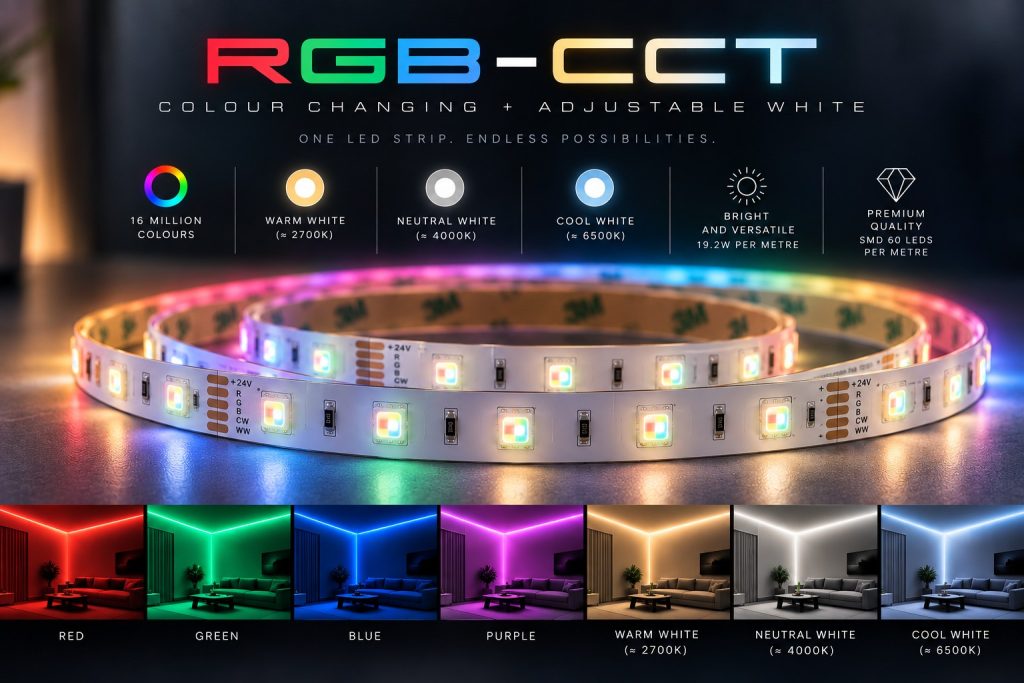
If you want even greater control over your white lighting, RGB+CCT LED strip takes the RGBW concept a step further.
CCT stands for Correlated Colour Temperature.
Rather than having one fixed white colour temperature, RGB+CCT incorporates both warm white and cool white, allowing the colour temperature of the white light to be adjusted.
You can therefore move from a cosy warm white through neutral white and towards a much cooler white using a compatible RGB+CCT controller.
Our SMD RGB+CCT strip has 60 LEDs per metre and a power consumption of 19.2W per metre.
Why is adjustable white useful?
The colour temperature of white lighting can completely change the appearance and atmosphere of a room.
A warmer white is often preferred when relaxing in the evening, whereas a cooler white can provide a cleaner, more contemporary appearance during the daytime or when more functional lighting is required.
RGB+CCT allows you to have both – without installing separate LED strips.
For example, you could use:
Warm white for relaxed evening lighting.
Neutral white for general everyday illumination.
Cool white for a crisp, contemporary appearance.
And then switch over to the RGB channels whenever you want colour-changing feature lighting.
This makes RGB+CCT one of the most versatile LED strip options available.
SMD RGB+CCT is particularly suited to:
- High-end residential installations
- Living rooms
- Kitchens
- Bedrooms
- Home cinemas
- Smart-home lighting
- Restaurants and hospitality
- Bars
- Entertainment spaces
- Multi-purpose rooms
If having control over the colour temperature of your white lighting is important, RGB+CCT is likely to be the most appropriate choice of the three.
COB RGBW LED Strip
COB RGBW provides a slightly different approach.
COB stands for Chip On Board and refers to the way the LED chips are constructed and mounted onto the strip.
Instead of the individual LED packages found on traditional SMD strip, COB technology allows a very large number of tiny LED chips to be positioned extremely closely together. This produces a much more continuous line of illumination.
Our COB RGBW LED strip contains an impressive 896 LEDs per metre, compared with 60 LEDs per metre on our SMD RGBW and RGB+CCT strips.
That exceptionally high LED density produces the characteristic smooth, virtually dotless appearance associated with COB LED strip lighting.
The difference can be particularly noticeable when the LED strip itself is visible, when it is installed inside a shallow aluminium profile, or when the light is reflected from surfaces such as glass, polished stone or gloss finishes.
896 LEDs per metre
The number sounds almost excessive when compared with the 60 LEDs per metre of the SMD alternatives, but this is fundamental to the way COB technology works.
Rather than seeing individual points of light, the LEDs blend together to create the appearance of a continuous illuminated line.
Our COB RGBW strip therefore combines this smooth COB appearance with RGB colour-changing capability and a dedicated white channel.
And despite having 896 LEDs per metre, it consumes 16 watts per metre, compared with 19.2W/m for our SMD RGBW and RGB+CCT alternatives.
COB RGBW is particularly suited to:
- Visible LED installations
- Shallow aluminium LED profiles
- Display lighting
- Shelving
- Media walls
- Furniture lighting
- Kitchens
- Bars and restaurants
- Architectural features
- High-end residential installations
If the appearance of the actual illuminated strip is particularly important, COB RGBW is an excellent option.
RGB+CCT vs RGBW – What’s the Difference?
This is perhaps the most important distinction to understand.
Both technologies provide RGB colour-changing lighting and proper white illumination.
The difference is control of the white colour temperature.
RGBW provides RGB colours plus a dedicated white channel at a specified colour temperature.
RGB+CCT provides RGB colours plus adjustable white, allowing you to move between warm and cool colour temperatures.
RGB+CCT therefore provides an additional level of control.
However, not every installation needs adjustable white.
If you already know that you want a particular white colour temperature – for example, warm white throughout a living room – RGBW can provide everything you need.
If you’d like to change the appearance of the white lighting depending on the time of day, activity or atmosphere you’re trying to create, RGB+CCT provides that additional flexibility.
SMD vs COB RGBW – What’s the Difference?
When comparing our SMD RGBW and COB RGBW strips, both ultimately provide the same fundamental lighting options:
RGB colour changing + dedicated white.
The biggest difference is how the light itself appears.
Our SMD RGBW strip has 60 LEDs per metre, while our COB RGBW has 896 LEDs per metre.
SMD therefore produces identifiable points of light along the strip, although these can be softened considerably when the strip is installed inside an appropriate LED profile and diffuser.
COB’s much higher LED density creates a far more continuous illuminated line and greatly reduces the appearance of individual LED points. This is one of the main reasons COB technology has become increasingly popular for architectural and direct-view installations.
Neither construction is universally “better”. The right choice depends on how and where the strip is being installed.
RGB+CCT, SMD RGBW and COB RGBW Compared
| SMD RGB+CCT | SMD RGBW | COB RGBW |
|---|
| LED density | 60 LEDs/m | 60 LEDs/m | 896 LEDs/m |
| Power | 19.2W/m | 19.2W/m | 16W/m |
| RGB colours | ✓ | ✓ | ✓ |
| Dedicated white | ✓ | ✓ | ✓ |
| Adjustable white CCT | ✓ | – | – |
| Warm-to-cool white control | ✓ | – | – |
| COB continuous light effect | – | – | ✓ |
| Technology | SMD | SMD | COB |
| Main advantage | Maximum colour-temperature control | Straightforward RGB + white | Smooth RGB + white illumination |
The important point is that each strip has its own strength.
Choose based on what matters most to your installation rather than simply comparing the number of LEDs.
Don’t Forget the LED Controller
Whichever option you choose, you’ll also need the correct type of LED controller.
An RGBW LED strip requires an RGBW controller, whereas RGB+CCT requires an RGB+CCT controller capable of independently controlling the RGB, warm-white and cool-white channels.
This is particularly important when planning a complete installation because the controller, receiver and control method all need to be compatible with the type of LED strip being used.
At LED Lighthouse, we supply compatible control systems for our RGBW and RGB+CCT LED strips, allowing you to create anything from a simple remote-controlled installation to a more sophisticated multi-zone lighting system.
Need Help Choosing Your LED Strip?
There isn’t one LED strip that’s right for every project.
For some installations, the simplicity and performance of SMD RGBW makes it the ideal solution. For others, the adjustable white control of RGB+CCT is worth having. And where a smooth, continuous line of illumination is the priority, COB RGBW is difficult to beat.
The good news is that all three technologies allow you to combine colour-changing feature lighting with practical white illumination from a single LED strip.
At LED Lighthouse, we’ve been supplying LED strip lighting and control systems for many years and can help you specify the right LED strip, driver, controller and aluminium profile for your project.
If you’re unsure whether RGBW, RGB+CCT or COB RGBW LED strip is best for your installation, get in touch with our team. Tell us what you’re trying to achieve and we’ll help you put together a complete lighting solution.