What is an LED Driver?
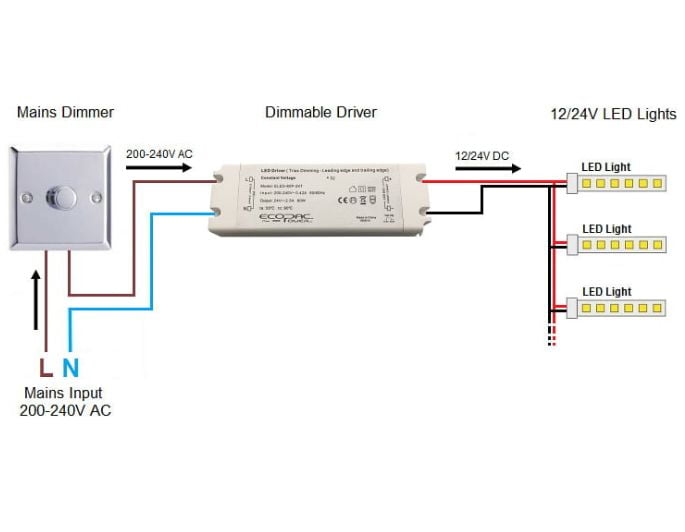
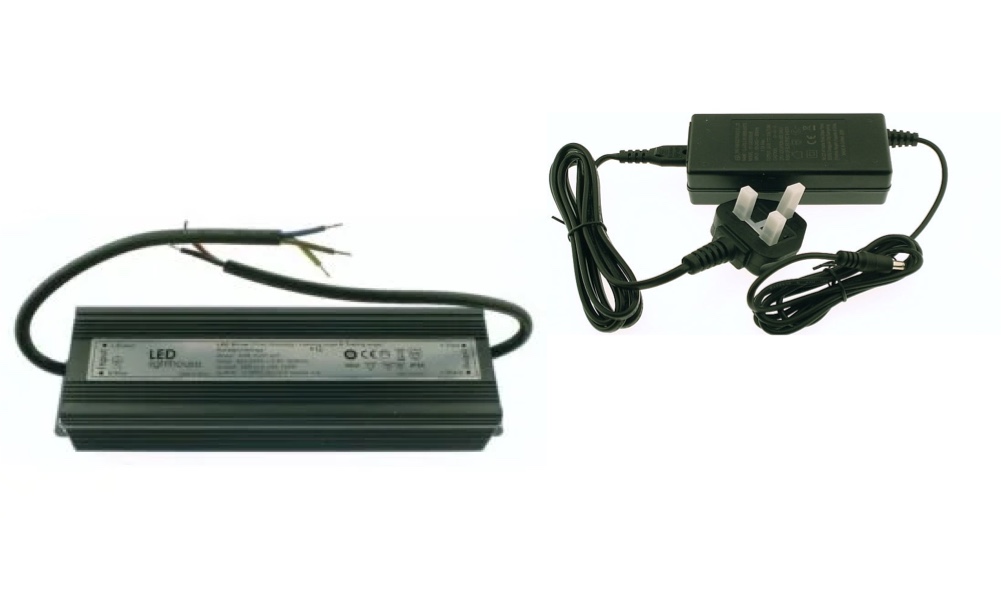
An LED driver (sometimes referred to as an LED power supply) converts the UK’s 230-240V mains voltage into the low voltage required by LED strip lighting.
Most LED strip lights operate on either:
Without a suitable driver, your LED strips cannot operate safely.
Think of the driver as the engine room of your lighting system. Whilst hidden from view, it determines the performance and reliability of the entire installation.
Standard LED Drivers vs Mains Dimmable Drivers
There are two main categories of LED drivers used with LED strip lighting.
Standard Switching Power Supplies
Standard drivers provide a constant output voltage to your LED strips.
These drivers are ideal when:
- The lights are simply switched on and off
- Dimming is controlled via a remote control system
- Dimming is controlled through an RF receiver
- Dimming is controlled using a smart home controller
Benefits include:
- Lower cost
- Excellent efficiency
- Compact size
- Wide range of wattages available
- Suitable for almost all LED strip installations
At LED Lighthouse, standard drivers are available in both 12V and 24V versions ranging from 12W up to 320W depending on the application.
Triac (Mains Dimmable) LED Drivers
Triac dimmable drivers are designed for installations where you wish to use a traditional wall dimmer switch.
These drivers allow the LED strip to be dimmed directly from the mains side of the circuit.
Typical applications include:
- Kitchen lighting upgrades
- Media walls
- Living rooms
- Renovation projects
- Existing dimmer switch installations
Benefits include:
- Uses familiar wall dimmer controls
- No additional receivers required
- Ideal for retrofit installations
- Smooth dimming performance
LED Lighthouse offers mains dimmable drivers in:
for both 12V and 24V LED strip systems.
12V vs 24V LED Drivers
One of the most common questions we receive is whether customers should choose a 12V or 24V system.
12V LED Systems
12V LED strips are commonly used for:
- Smaller installations
- Caravan and motorhome lighting
- Boats
- Display cabinets
- Shorter LED runs
Advantages:
- Widely available
- Suitable for battery-powered applications
- Shorter cut points on many LED strips
Disadvantages:
- Higher current draw
- Greater voltage drop over longer distances
- Requires additional power feeds on larger installations
24V LED Systems
24V systems have become the preferred option for most modern installations.
Advantages:
- Lower current draw
- Reduced voltage drop
- Longer continuous runs
- Better performance on larger projects
- More efficient operation
Ideal for:
- Kitchens
- Bedrooms
- Commercial projects
- Media walls
- Garden lighting
- Whole-home installations
For most domestic and commercial projects, we recommend 24V LED strip lighting wherever possible.
Understanding Driver Wattages
A driver must always be capable of supplying more power than the LED strip requires.
As a rule of thumb, we recommend leaving approximately 10-20% spare capacity.
For example:
- LED load = 80W
- Recommended driver = 100W
This improves reliability and reduces operating temperatures.
Driver Size Matters
One of the most overlooked parts of planning an LED installation is making sure there is sufficient space for the driver.
As power output increases, driver size also increases.
Generally:
| Driver Size | Typical Installation Location |
|---|
| 30W-60W | Kitchen cupboards, cabinets |
| 100W | Cupboards, wardrobes, service voids |
| 150W-200W | Utility spaces, ceiling voids |
| 240W-320W | Dedicated service areas |
Always check the driver’s physical dimensions before finalising your installation.
Many installation problems occur because a customer purchases a driver that physically will not fit into the intended location.
Indoor vs Outdoor Drivers
LED drivers are available in various IP ratings.
Indoor Drivers
Suitable for:
- Dry internal environments
- Kitchen cupboards
- Bedrooms
- Living rooms
Benefits:
- Smaller
- Lower cost
- Easier to conceal
Waterproof Drivers
Typically rated IP65 or IP67.
Suitable for:
- Bathrooms
- Outdoor lighting
- Garden projects
- Damp locations
Benefits:
- Weather resistant
- Dust resistant
- Longer lifespan in challenging environments
Many of the larger Mean Well drivers supplied by LED Lighthouse are available with IP65 or IP67 protection ratings.
Installation Tips
Before installing any LED driver:
1. Allow Ventilation
Drivers generate heat.
Never completely enclose a driver in insulation or seal it inside an airtight compartment.
2. Leave Spare Capacity
Avoid running a driver continuously at 100% load.
A driver operating at 80-90% capacity will typically last longer and perform more reliably.
3. Match Voltage Correctly
Never connect:
- 12V strips to a 24V driver
- 24V strips to a 12V driver
Doing so can permanently damage the LED strip.
4. Position for Future Access
Drivers are electrical components and may need future replacement.
Always install them somewhere accessible.
5. Consider Future Expansion
If you may add additional lighting later, installing a larger driver now can save time and money in the future.
Need Help Choosing the Right LED Driver?
Choosing the correct LED driver doesn’t need to be complicated.
At LED Lighthouse, we stock a comprehensive range of:
- Standard 12V LED Drivers
- Standard 24V LED Drivers
- Mains Dimmable 12V Drivers
- Mains Dimmable 24V Drivers
- Waterproof Drivers
- Mean Well Professional Drivers
Our online LED Driver Calculator can also help determine the correct driver size for your project based on the LED strip you are using and the total length of your installation.
If you’re unsure which driver is right for your project, contact our technical team and we’ll be happy to help design a complete LED strip lighting solution tailored to your installation.